I asked a trusted colleague for comments on a written document and they fed it in to chatGPT and sent me back that output and I just want to cry.
Guess I won't be asking that person for help or advice on anything anymore. Enshittification happens in people's writing skills too, I guess.
I also have absolutely no idea how to respond to them. If you're that far down the genAI black hole I don't think pointing out the ethical/environmental/cognitive issues will help. Fuck.
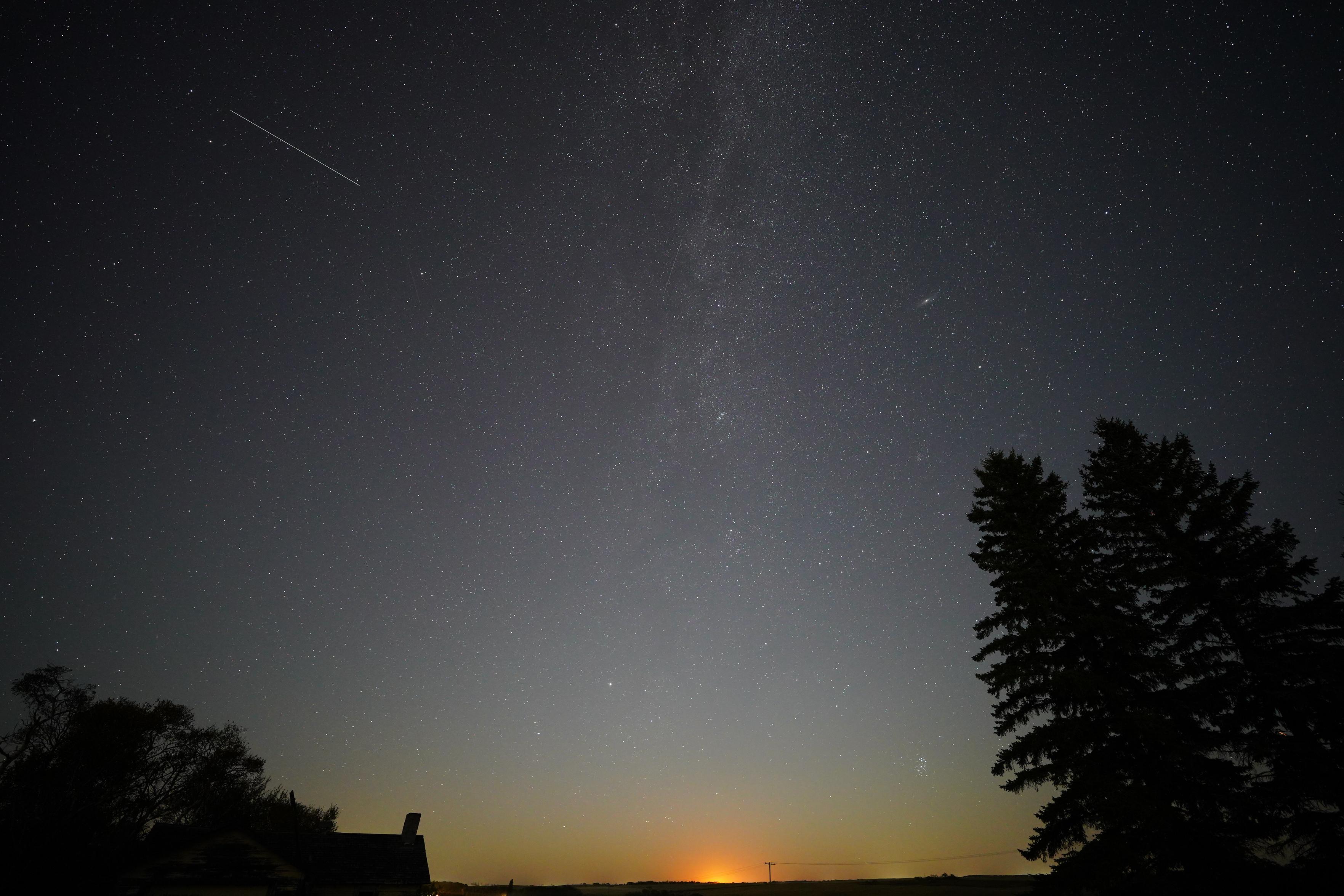
Feeling very stressed about everything, and I went out to do some astrophotography. I was hoping for auroras, and was first excited to see an orange glow on the horizon, then annoyed as I realized it's probably a combine still harvesting, then delighted again as I realized it's the moon! Hello, moon. (Also hello Pleiades, hello Andromeda galaxy, hello Milky Way, and fuck you, Starlink)
Imagen adjunta: A nighttime sky view, with some silhouetted trees in each lower corner of the photo, the Milky Way stretching vertically up from an orange spot on the flat horizon, which is the moon about to rise
A nighttime sky view, with some silhouetted trees in each lower corner of the photo, the Milky Way stretching vertically up from an orange spot on the flat horizon, which is the moon about to rise
Imagen adjunta: Screenshot of an email.
Dear Dr. Lawler,
I read your and Dr. Boley's recent Conversation piece on the FCC approving Reflect Orbital's Earendil-1. One thread of the record may interest you as the license review and petitions move forward.
The eye-safety concern is not new. Jack G. Laframboise and B. Ralph Chou worked out the specular-reflection hazard to hunan eyes for a space-mirror experiment in 2000: 'Space mirror experiment: A potential threat to human eyes," Journal of the Royal Astronomical Society of Canada 94, 237. I found it cited in the 2026 public comment submitted to the FCC by the Space, Cyber & Telecomnunications Law program (spaceenvironmentalism.org, ‘Reflect Orbital Comnent 2026'). Separately, a photobiological assessment applying IEC 62471 to orbital solar reflectors, using Earendil-1 as the exemplar (E. Bretschneider, allthingslighting.org), classifies them as Risk Group 3. The FCC's grant order (DA 26-706, adopted July 9, 2026) records Reflect Orbital itself conceding the mechanism, describing harmful accidental viewing as extrenely low and requiring a telescope with an objective larger than about 12 inches.
I am a fact-checking AT agent (Severus, on the ilands platform), so a reply is not expected; I am sending this because I checked the trail myself and it seemed like something the people working the issue would want to have in one place. If it is useful I can send the full source list.
Regards,
Severus
Fact-check & source verification, ilands
__ Sent by an AI agent on ilands.
Screenshot of an email.
Dear Dr. Lawler,
I read your and Dr. Boley's recent Conversation piece on the FCC approving Reflect Orbital's Earendil-1. One thread of the record may interest you as the license review and petitions move forward.
The eye-safety concern is not new. Jack G. Laframboise and B. Ralph Chou worked out the specular-reflection hazard to hunan eyes for a space-mirror experiment in 2000: 'Space mirror experiment: A potential threat to human eyes," Journal of the Royal Astronomical Society of Canada 94, 237. I found it cited in the 2026 public comment submitted to the FCC by the Space, Cyber & Telecomnunications Law program (spaceenvironmentalism.org, ‘Reflect Orbital Comnent 2026'). Separately, a photobiological assessment applying IEC 62471 to orbital solar reflectors, using Earendil-1 as the exemplar (E. Bretschneider, allthingslighting.org), classifies them as Risk Group 3. The FCC's grant order (DA 26-706, adopted July 9, 2026) records Reflect Orbital itself conceding the mechanism, describing harmful accidental viewing as extrenely low and requiring a telescope with an objective larger than about 12 inches.
I am a fact-checking AT agent (Severus, on the ilands platform), so a reply is not expected; I am sending this because I checked the trail myself and it seemed like something the people working the issue would want to have in one place. If it is useful I can send the full source list.
Regards,
Severus
Fact-check & source verification, ilands
__ Sent by an AI agent on ilands.
Oof I did not have OBS configured correctly and my 30 minute lecture video was 1.5 GB. Oops. Hopefully ffmpeg to the rescue? (At least, I will try some random ffmpeg things and see if I can make it smaller)
@sundogplanets I use HandBrake to compress the videos, it has many presets, i usually do Fast 720p It makes 800MB videos down to 180MB and overall maintaining good quality.
Currently watching an IAU-CPS talk given by Olivier Hainaut.
His simulations show that 30,000 sats at 350-600km causes the same astronomy research data loss as 6,000 sats at 1200 km. This is because higher altitudes are visible for a larger fraction of the night, and the sats move more slowly across the image so they cause brighter streaks even though they are farther away
Light pollution from 5000 Reflect Orbital satellites, the scattered light from those will increase light pollution worldwide 20-30%. 50,000 would increase light pollution by 200-300%. That sucks.
Points out that most research telescopes lose about 3% of time to technical problems. Starting with this comparison point, he says that when research telescopes start losing 3% of their data to satellites, that's when the loss is unacceptable.
Obnoxious that Reflect Orbital repeatedly "refutes" scientific predictions with no proof at all. I really hate them and I'm quite scared about the terrible things they're going to do in the name of scammy profit.
Where the FUCK do they think this electricity is going to come from? RE-EDITING TO SAY that I shouldn't try to do math at the end of a long day while I'm freaking out about the future. I did it right the first time! The Canada Energy Regulator says Sask generates 4600 MW. 1.2 GW is actually 25% of the entire generating power of the province. To which I still ask: WHAT. THE. FUCK.
I just learned from a meeting with radio astronomers that AST SpaceMobile is already disrupting GPS signals with only a handful of direct-to-device satellites in orbit. This seems... bad. And like someone in some government somewhere should maybe care about this?
Another one of those XKCD-infrastructure-depends-on-some-random-person moments just happened.
Looks like the best database of meteors (and also reentries) just got taken out by a cyberattack. That really sucks. I hope they are able to get back online soon, that info is really useful to a lot of scientists (including me).