*Old people in big European cities afraid of the sky


*Old people in big European cities afraid of the sky
@bruces l At least in Germany the old people are more afraid of air conditioners than of the heat. Source: i tried to gift one to my mom...
*Hey wait... where are the shoggoths? I really miss all those shoggoths

@bruces I was confused by the idea that Meta has an intelligence layer, but the rest of it rings true.
@bruces where is this from? I'd like to read rhe rest of that, please.

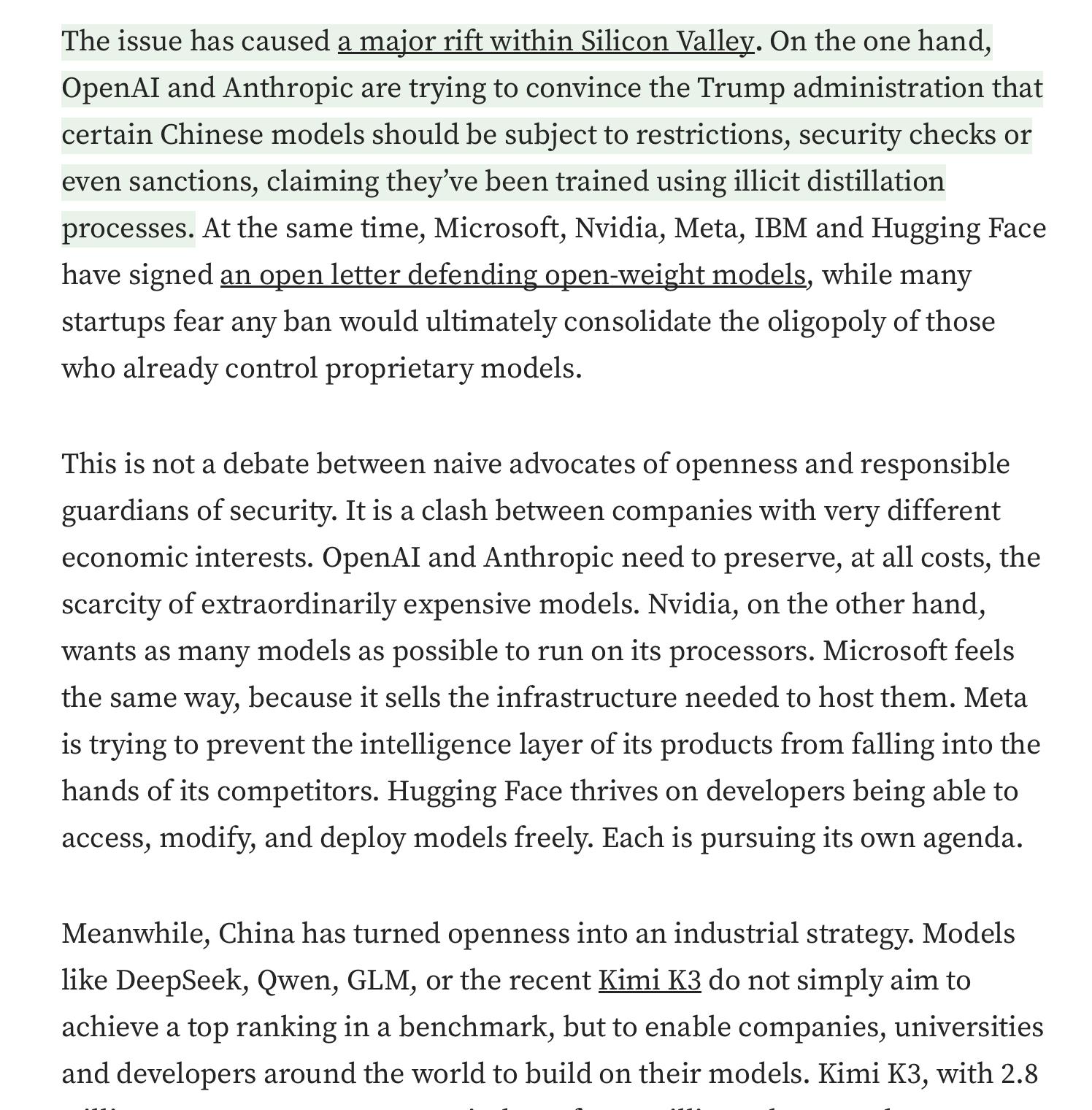
The issue has caused a major rift within Silicon Valley. On the one hand, OpenAI and Anthropic are trying to convince the Trump administration that certain Chinese models should be subject to restrictions, security checks or even sanctions, claiming they've been trained using illicit distillation processes. At the same time, Microsoft, Nvidia, Meta, IBM and Hugging Face have signed an open letter defending open-weight models, while many startups fear any ban would ultimately consolidate the oligopoly of those who already control proprietary models.
This is not a debate between naive advocates of openness and responsible guardians of security. It is a clash between companies with very different economic interests. OpenAI and Anthropic need to preserve, at all costs, the scarcity of extraordinarily expensive models. Nvidia, on the other hand, wants as many models as possible to run on its processors. Microsoft feels the same way, because it sells the infrastructure needed to host them. Meta is trying to prevent the intelligence layer of its products from falling into the hands of its competitors. Hugging Face thrives on developers being able to access, modify, and deploy models freely. Each is pursuing its own agenda.
Meanwhile, China has turned openness into an industrial strategy. Models like DeepSeek, Qwen, GLM, or the recent Kimi K3 do not simply aim to achieve a top ranking in a benchmark, but to enable companies, universities and developers around the world to build on their models. Kimi K3, with 2.8