
Henna Virkkunen

@HennaVirkkunen@ec.social-network.europa.eu

Perfil original

Protecting children online is one of the Commission's top priorities. Children’s attention must not be a commodity.

Today in the European Parliament plenary we discussed the proposed KIDS Act and its gradual and age-appropriate approach to social media.

Today’s debate has shown the determination to make the online world a safer place for children and generations to come.
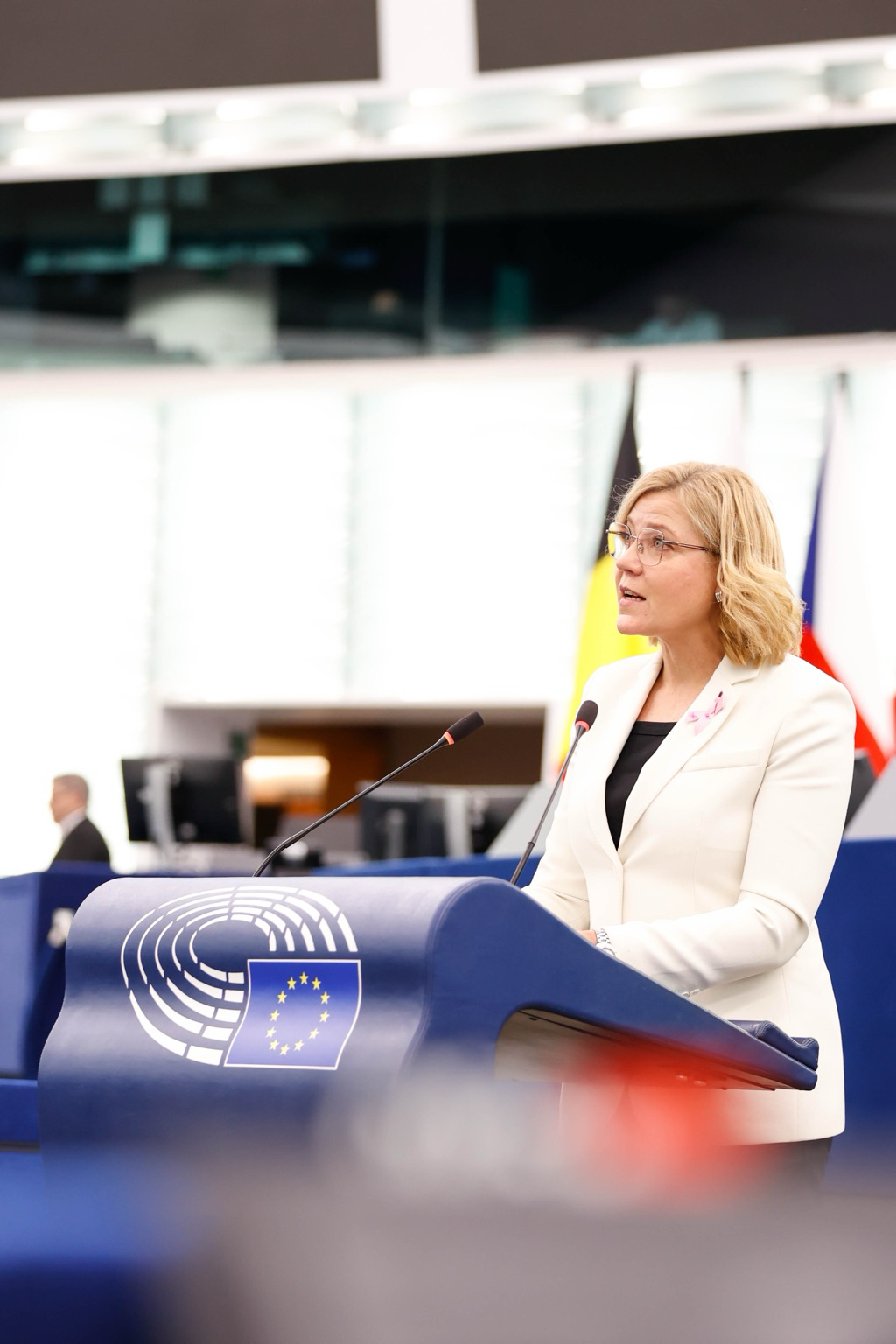
Imagen adjunta: EVP Virkkunen speaking in the European Parliament plenary in Strasbourg.

Impulsos
9 de junio de 2026

The Festival of the New European Bauhaus is officially open.

From 9–13 June in Brussels, innovators, creators, citizens and communities will come together to showcase ideas and projects shaping a sustainable, inclusive and beautiful Europe.

Discover the full programme: ec.europa.eu/assets/jrc/NEB/ne

Imagen adjunta: Promotional poster for the Festival of the New European Bauhaus. Against a bright blue background with large yellow graphic shapes, two hands of different skin tones link pinkies in the foreground while star-shaped confetti fills the image. The text reads “The Festival of the New European Bauhaus – Life. Spaces. Buildings.” and “See. Hear. Celebrate.” The poster announces the festival in Brussels from 9–13 June 2026 at the Art & History Museum and Parc du Cinquantenaire, alongside the European Union flag

9 de abril de 2026

Keeping kids safe online is a top priority.

Today, the Commission has preliminarily found porn platforms Pornhub, Stripchat, XNXX, and XVideos in breach of the Digital Services Act for allowing minors to access adult content.

We’ve also launched investigation into Snapchat under doubts that the platform has failed to adequately protect minors from harmful content, grooming, and illegal products like drugs and vapes. We also suspect that they have failed to verify users age sufficiently.

Imagen adjunta: EVP Virkkunen sitting and watching out the window.

@david @bjoreman @HennaVirkkunen that site somehow doesn't seem to work here. But in general, these proposals fail, because sites can regularly probe for age brackets. If you do this on a regular basis, you can figure out someone's birthday.

E.g. if 12 years is a bracket boundary, the day that age gets attested is the birthday of the kid. Even more likely because someone is more likely to check close after their birthday to unlock some site/functionality.

@david @bjoreman @HennaVirkkunen The problem with most age attestations is that you can work out someone's birthday by keeping track of past attestations. When the attestation changes, someone had their birthday, thus the attestation gives away information that someone might not want to reveal.

This gets worse with implementations with which you can test age brackets (different age brackets under 18, to allow some content).

@david @bjoreman @HennaVirkkunen Also, age verification is strongly detrimental to open source and your freedom to choose your OS.

Most implementations of 'anonymous' age verification require remote hardware attestation (eventually), because otherwise you can manipulate the app/process that partakes in the attestation.

Mandatory remote attestation is pretty much the end of free OS choice, because you running your own non-approved software will shut you out of services.

H

@HennaVirkkunen I think officials should re-examine the unspoken assumption that small children must be hooked up to whatever remote computers.

Car analogies work well in this area. If the Internet is the "information superhighway", then why are parents expecting little Johnny and Susan to play out on the highway? Just a generation ago it would have been framed as abuse and neglect, but now our children must somehow be steeped in the SV wizardry or else they will wither on the vine...?

H

@HennaVirkkunen

Are you suggesting it would be safe for EU citizens to submit their passport details to services like PornHub?

I think the sentiment is good but for age verification to work it needs to be provided as a service on EU/local governmental level to not leak sensitive information.

Unfortunatly not all countries have the faith in their goverment the same way we in Finland have, and in some cases for good reason, so age verification will be tricky to implement.

H

@HennaVirkkunen how exactly these platforms should identify minors? And what would prevent minors from using a VPN to connect from a country that doesn't put such restrictions? Also, let's say you target the big players and VPNs are not a thing: how much time does it take to people to migrate to other less known porn sites, potentially being exposed to higher risks (e.g. viruses)?

H

@HennaVirkkunen How do you suggest the platforms should do that? The lazy way everybody around pushes results in the platforms storing huge ammouts of data with government issued IDs. If you don't trust them with child protection, do you really trust them to keep that data private, not leak them and not misuse them?

So please, really think through the next steps. Cause so far I see only really stupid solutions for this issue, resulting in weakening privacy in the name of protecting children.

H

@HennaVirkkunen I understand all the concerns here, but do we realy want minors to grow up watching 5 dudes in a group r*pe like scene do a young underaged looking woman with pain in her face, urinating on her, thinking that's normal and they have to do or accept this in their later lifes?

Those are contents minors find behind these companies "Are you 18 years old? Klick yes or no!".

This is irresponsible!

H

Dear @EUCommission and @HennaVirkkunen
Please consider what the world wide community of scientists for computer security and privacy, who are studying the impacts of technology on society, have to say on this topic. They published an open letter, signed by more than 400 scientists in the field, calling for a (temporary) moratorium on age verification online earlier this month:
csa-scientist-open-letter.org/

Forcing consumers to reveal their identity to data abusers keeps no one safe, not children, not adults. Breaking and bypassing privacy technology actively makes the Internet less safe. Curtail data brokers and abusive targeted ad industry, regulate and monitor what GDPR already legislated.
@HennaVirkkunen